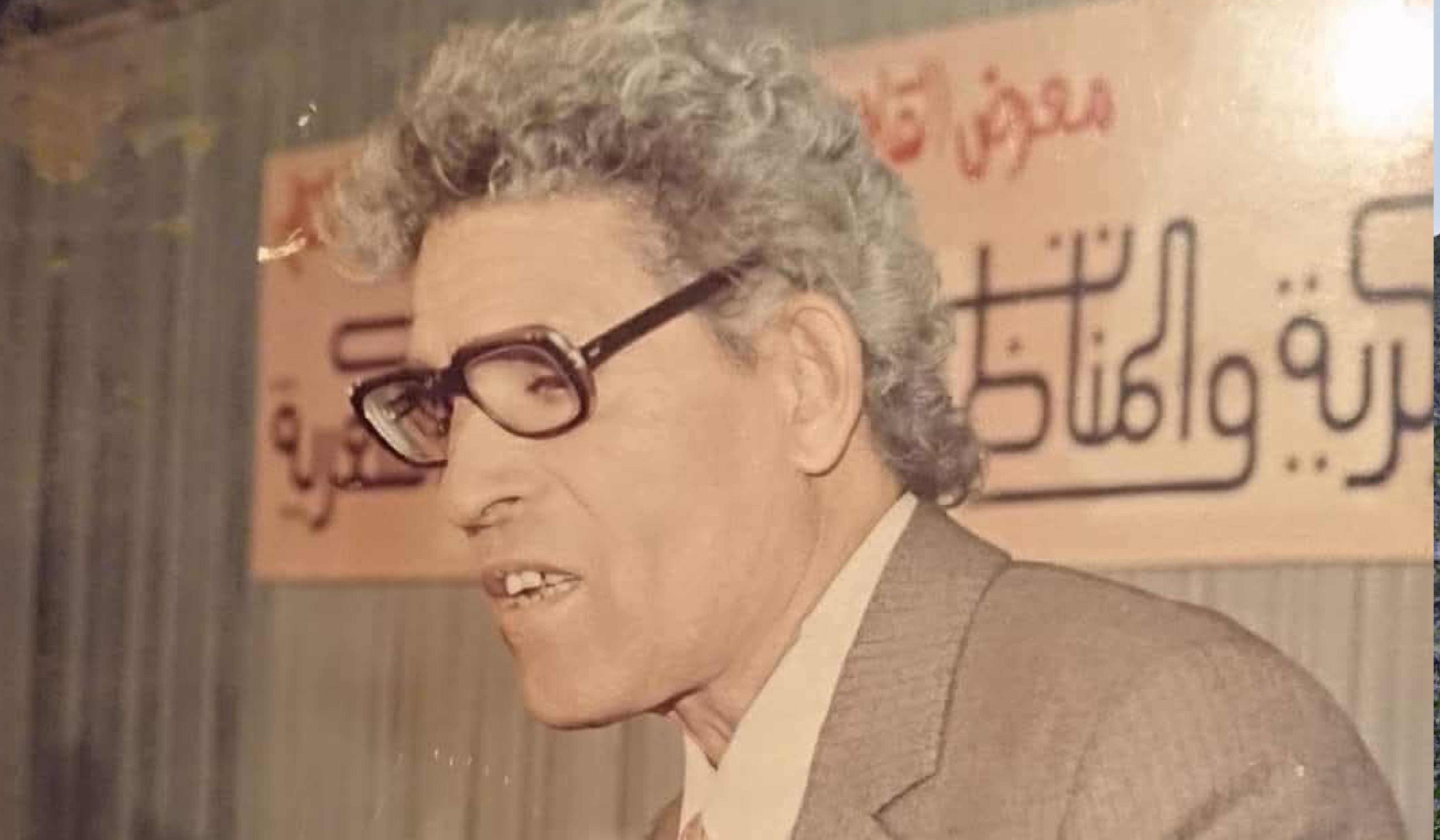

Muhammad al-Miyam
An Egyptian poet and writer.
Yesterday, the 90th anniversary of the birth of the late Egyptian poet Mohammed Afifi Mutar, and once the name of Afifi Mutar was mentioned in any forum, it took place on the Sunshine as his famous Arab sentence. Is a man and I beat him coming back? Even my waist at the poet became a stark sign of clarity in anger and satisfaction, but our Arab sign that we only know our own culture if they do their idea, as with my elfia, who injected the detainee and his bones!
He lived in an active ingredient, driven by the formal institution ' s ceremony, the prophet -- without a declaration -- from the cultural community ' s bastards, on the back of his elusive glue -- they claimed -- and on the ground that he had an importation of his own ideology -- which he had on his own.
They were killing him, and he knew, and he was honored in his opponents; no pilgrimage is his thing, no reproaching, his passion, his delusion of the old Arabian poet, no depravity, no foul play at the singer.
I'm told by an Egyptian novelist who moved him, that one evening in Paris, she brought me a hearing with a famous Arab poet and three French educators, and the Arab poet mocked the character of Omar Ben Al-Sabah, who was no savage but sprinkled him with the glass before him!
The stalker could easily accus me of violence, but in fact his behaviour was not aggressive against the man or defender of the son of a speech, as much as he was saving the water of the Arab face as he was lying on the Paris tables, glowing to its brightness, not a serious and genuine knowledge debate!
In his group. "People face features.""He writes in 1966:
"The right may be said twice:
Once the Wizard says it.
And once the sword says it!
My uncle, an old prophecy, has been saying it since his group.From the starters.And the sword also has his venomous word, influenced her on the nose of my devastated bloody nose, and Lazagley is a witness to the signatory!
In his book. Tales of good people. The dictator, Said Al-Kafraoi, writes a testament to crying in time of laughter, tells me about his visit to a raincoat in prison, says:
«The sheriff pulled a bell in, and a soldier came in, and the sheriff asked him to bring a rain, and I got caught up in front of me like smoke strings.»I'm sorry.
It was an Arab forebear, and its foresights, even the richness of it, pure Arab, at the level of grain, horses and poetry, a stretch of hairy ancestors, unforgivable to them and untouchable to them, despite his encycloped culture and his ribs on the part of Arab civilization.
The poet paid for every word he said with a comfortable conscience, because his word belongs to him, and the imported words don't need to pay bills, from the uterus bears and even his uncle's stick, a mosquito in the toy, all his words were pure to him, and these are: his poems and paid price, his presence.
By reviewing the Arabic poetry blogger, the use of poets with the prophet does not come out of a pattern of three, either for the elderly and for the young, or for the taunting of the prophecy by the poet, on a bipolar/prophet basis, the poet ' s experiences of the prophet will be shared with the popularity, oppression and speculation:
And the third pattern is confusing the prophet's experience by giving her a new reading, trying to erode visions and produce new expressions of the ancient spiritual experience, consistent with our contemporary concepts without empirical dictations, which we have clearly demonstrated in the delusion of his faith. "You're one of them and your organs are broken."That came like this:
"Pulse of calm."
To a baptism...
Master of the Lungs.
And the vision of divorces of every sex.
All tears.
It's open to the hungry.
And the rhythm of life in the body of the world."
The critic, Dr. Salah, sees in his study, that my forgiveness was going to implicate the reader in the confusion between the poet and the prophet, but I see this as the inclusion of my sanctuary in the second pattern of poetry - wearing masks!
A clear and unambiguous gift, referring to a particular belief nature, is that when the poet believes in the messenger, it is carried out into the essence of the message, and it is translated into the true meaning of the prophecy, meaning that the prophecy came only to get people out of the narrow category to the capacity of mankind, to heal the hungry, and to impress life in the body of the world.
So he took them in schizophrenia and pride, and when they were held to the shadows of the prophet, he reads and lives the experiment, throws them in the sylphilis, doesn't heel, and reads his poem. "Woman not now."Don't come in front of me without cheeks, although there's no direct mention of her, but giving the bold voodoo to Muhammad, the fever of my mind is up to its utmost, especially with words such as:
- Believe what you're dreaming, time's wider.
- Forty of the ages were born.
- They pulled you out of the ground. Their conversations were a language you're not.
- Don't promise them if they enter the dream or come out.
- Are your exits from your plans or the Earth?
- Summer and wool came to me under heaven's space.
- The family ring is lit, and that's my woman.
- You're not alone.
- Are you leaving?
- What are they and time not us?
Throughout the poem, the evidence is referred to as a veteran role in the experience of the prophecy, without mention of cheeks or prophets.
In his ingenious sword. Book of appeals.As part of his petty work, he speaks in the chapter of "The Greatest Call" of five who made a change in history; they are two men, women, children and slaves, and he says:
"They were five who never met in a place or time before or after, and five like them did not speak a cosmic coup that changed the geography of souls, minds, hearts and history of the earth as they did; a man and a woman, the parents, the thousands of sons in history, their brotherhood, the creativity of the temple, the heart of the souls, the hearts of history.
Did you know the five?
Prophets, Khadijah, Abubakar, Ali and Balal/Abdul Al-Raq al-Ahd al-Ahmar, believed in a cradle of religion, defended against fundamental kidnapping and anti-Anzeki in front of the incoming/emergency idea, and lived a true vigilante, eating out of his hand, and not fighting over the royalty. He has peace!