
Nabil Abdul Karim
A writer shot me.
If it's a poet, what do you say?
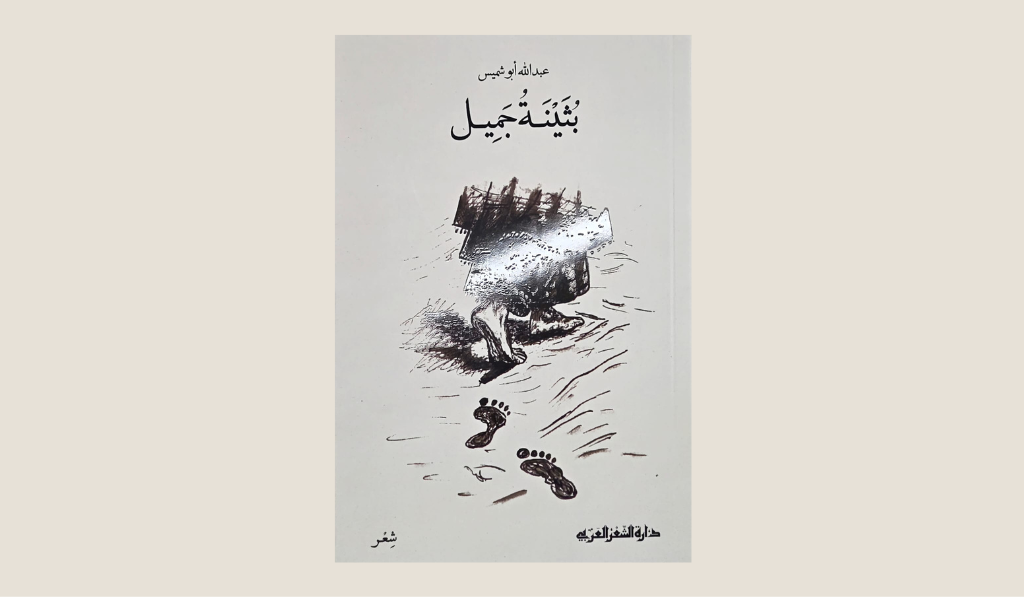
The two most important places of the Arab poet in El Fajira, the Jordanian poet Abdallah Abu Shamis, which is based on the stereotyping of women from their marginalized or secondary positions in Arab Muslim history, religious and literary, and calling them back to the holy circles.
Diwans are 100 and 12 pages, with 12 poems, all with single addresses, not a composite address, and in single headings a sign of the interconnection, regularity and integration of poems in a decade that is surrounded by a richness and character in all its aspects, in terms of lighting each address of its characteristic features and complementarity. In addition to its poetic image in the commune of Jamil Ben Muammar, the author of the junta has undoubtedly used historical sources that have seen things from her circuit outside a beautiful mirror, as well as recent studies that have analysed her human personality and illustrated the social environment with which the poet ' s story has been framed.
In this poem, it is self-evident to say, to express itself, to go to a beautiful place that you describe as a poet, the first poem is a form of foundational speech, which is given a price for every location.
Give me the shot.
Some holes.
I run into it.
Heavy fine.
The second poem of religion is a poem, a poem, with the same value as it is, not as beautifully painted, and as poets then take a stereotypical picture of a paralyzed woman, a flower, a flower, and a rainy gem, saying to speak to poets:
Then you'll see.
From the search.
Speakers.
Believe in me.
As am I.
Not like a price.
Not like her name.
In the name!
It's a beautiful thing to say in the third poem, the invader, the inflammatory cash arrows, and his narcissism, which has prevented her from loving her natural love, apart from her haircuts, making her a subject of his poem.
Hey.
You don't like a price.
Unless the poems glow in you...
You touch me, you shine.
And run to the wilderness.
And the fourth point, the fire tells about the love that was born distorted by its mix of hair pollution that it had decided not to be approved by the Bedouin community in the village valley; the relationship between the two lovers was governed by a bad end, and they were not labeled unscrupulous and lost:
Both of us.
He missed himself.
And he went on the road to drink...
Both of us.
If he sees his face.
Without his boyfriend.
Be careful.
The fifth poem, Sham, shows the sound of a lover, the express expression of her beloved emotions, the boldness of her bloom with her lovers, the impulse of revealing her lipsticks on his journey from the Jazz to the Sham, destroying a picture of the price of the intractor he has devoted to a beautiful, swollen image, and utterly.
You're the one who set up a nirani.
And you honored me.
Here I go.
Like a clown.
In the night of Heaven.
The sixth poem, the Frost, is made clear of the bitterness generated by paradoxes in a rich and beautiful tale, and it's a bluntly beautiful marriage, asking a beautiful, beautiful lover to express a beautiful position.
You'll be long.
After a second,
But you will.
Beautiful.
You're gonna make it.
One more.
You hug her in poems.
You'll sing.
For her and for yourself.
A song you've been playing with.
Up my lap,
He's going to bloom.
And the night of the singer...
But, you see,
How much will you sing?
That one about me?
The 7th (cell) poem reveals a valuable face, an analyzed face of excuses of indignity, and at the same time its feminine feminine delusion, a foetus of her unscrupulous lover, and the invisibility of a priceless person in this poem, which strikes a frustration against her own identity.
Hurry, hurry.
Come on.
I want you.
In my hands.
Here.
Now!
You've gone too far.
In the shadow.
It's time to go back.
For colors.
Tonight.
We're getting married.
This virgin love.
And stab the deprivation chest.
The eighth poem, Elle, is a very valuable poem after time has spared her story with beautiful, and she has lived years later, her story has been shattered from the shadow of the distant past, with doubts in the minds of those who have not been so beautiful, who have never known a price in her trap, and her daughter ' s question of the validity of the story reveals how beautiful the woman is.
Beautiful.
I grew up a lot.
He didn't stay with me.
Just a drum.
In poems.
Looks like his eye.
Skunk.
The ninth poem (the river), in which it shows its narcissistic face against a beautiful narcissism and its excessive self-esteem, meets his male selfishness with her feminization, and responds to his exodus by his jealousy:
And the love I have is equal.
I don't.
Between who came yesterday.
And who will come tomorrow.
You were their master when you were.
The servant of my great river.
But...
A price.
You never had a master.
In the ten-year-old poem, she revels on her human face, just from the masks of the traitors I wear beautifully to her, and she begs her to wear it for the image of a cruelly emotionally consumed woman, and by revealing her fragility and weakness, if her lover asks her to share the same masks with him.
Beautiful.
What are you traveling like a cloud?
Up my throat.
You fuse without your hands, my teeth.
And drift.
In the 11th poem, Jamil reveals the interconnection and separation of lovers, their coalitions and differences, in a complex, admirable, dispersed by different impressions, bound by the need for the other with a strong bond, each with each other, and their feelings towards him, with satisfaction, but the longest sense of despair was that the relationship was ruined.
He was crying like a child.
And laugh...
As water pleases.
And he gets shot.
And I was.
Storm like him.
We fell fine.
Fight.
Fight.
The conclusion of the poems (the widow), a beautifully disrespectful one, the end of the human story, the beginning of the literary story, but the second she inherits herself with beautiful, closes her heart, declares herself (the widow of love), and the human and literary tale is all the same:
Is that love?
Dude.
We threatened.
Predictable.
He didn't stay from us.
Only a trail.
And as soon as we wave.
Affect.
In this religion, and in its previous years, with the artifacts of artisanal artifacts, it is not possible to do so in this place.